How Big Should My Stash Be?
More is not better. The right stash covers your first days back at work without taking over your freezer or your mind.
Staff writer
8 min readSeptember 27, 2026
There's a particular kind of anxiety that settles in around week three of pumping: the freezer stash math anxiety. You open the freezer, count the bags, do mental calculations about ounces and days and return-to-work dates, and feel either a flood of relief or a spike of panic. If you're in the panic camp, take a breath. The oversized freezer stash you've seen on social media—hundreds of ounces, color-coded by date, stacked like bricks—is not a requirement for successful breastfeeding. It's an outlier, often the product of oversupply, anxiety-driven overpumping, or simply a different set of circumstances than yours. Your stash needs to match your life, not someone else's highlight reel.
What a stash is actually for
Before we talk numbers, it helps to get clear on purpose. A freezer stash is a buffer, not a primary food source. For most working parents, the day-to-day plan is this: baby eats what you pump that day (or the day before), and the freezer stash exists to cover gaps—a low-output day, a missed pumping session, a sick day, a trip away from baby, or the first wobbly week or two of daycare or a new caregiver learning your baby's cues.
This distinction matters enormously, because it changes the target. You are not trying to build weeks of backup food. You are trying to build a cushion for the unpredictable days that inevitably happen when you're juggling a pumping schedule with a job, a commute, and a baby who doesn't always nurse or take a bottle on cue.
Think of your freezer stash as a shock absorber, not a reservoir. It softens bumps; it doesn't need to carry the whole load.
A realistic number to aim for
If you want a concrete target, aim for 2–4 days' worth of milk, based on what your baby typically eats in 24 hours once they're exclusively on bottles for feeds you're not present for. For many babies between two and six months, that's roughly 24–32 ounces total—calculated as about 3–4 ounces per feeding, spaced over the hours you're apart from your baby.
Notice what that number is not: it's not weeks, and it's not months. It's a few days of coverage, which is enough to absorb a rough patch without triggering a full-blown crisis. If you're able to pump at work consistently and your supply is well-established, a modest stash like this is genuinely sufficient for most families.
Where this shifts is your specific return-to-work timeline and pumping access. If you're returning to a job with unpredictable breaks—think certain shift work, travel-heavy roles, or jobs where pumping access is inconsistent despite legal protections—a slightly larger buffer of 4–7 days can offer real peace of mind. The goal is matching your stash to your actual risk of a missed or shortened session, not to a hypothetical worst case that may never occur.
Working backward from your return date
Rather than pumping and freezing indiscriminately for months, it helps to work backward from your return-to-work date. If you have 8–12 weeks of leave, you don't need to start stockpiling in week two. Milk production is a demand-driven system, and overpumping early—adding extra sessions on top of full, satisfying nursing—can push you toward oversupply, which brings its own complications: engorgement, clogged ducts, mastitis risk, and a baby who struggles with an overwhelming, fast letdown.
A gentler approach: in the two to three weeks before you return, start adding one pumping session a day, typically in the morning when supply tends to be highest, about 20–30 minutes after a nursing session or an hour before one. This gives you a modest, steady accumulation—often an ounce or two extra per session—without destabilizing the supply-demand balance you and your baby have built.
If your leave is shorter, say six weeks or less, this slow-build approach may not leave much runway, and that's okay. A smaller stash built from whatever you can collect, combined with confidence in your at-work pumping routine, is still a workable plan. Many parents return to work with a modest few days' buffer and simply catch up by pumping consistently once they're back.
Accounting for your real pumping conditions at work
Your stash size should reflect the honest answer to a few questions. How many pumping breaks will you realistically get, and how long are they? Is your pumping space private, comfortable, and accessible without negotiation each time? Does your commute or schedule mean you'll sometimes miss a session?
If your workplace is supportive and your breaks are protected and predictable, you can lean toward the smaller end of the range—closer to 2–3 days. If you anticipate friction, inconsistency, or a demanding schedule where pumping might get skipped some days, build toward the 5–7 day range, and consider also keeping a small emergency stash of 8–12 ounces set aside and not touched except for true emergencies, like illness or travel.
It's also worth asking your caregiver or daycare how they plan to feed your baby. Paced bottle feeding, which slows the flow and mimics breastfeeding's natural pacing, tends to result in babies taking appropriately sized bottles rather than over-feeding out of habit or boredom. A caregiver using paced feeding will typically use less milk per session than one feeding on a traditional fast-flow schedule, which can meaningfully affect how much stash you actually burn through.
What to do if your stash feels too small (or too big)
If you're closer to your return date and your stash feels thin, know that a small stash is not a failure. You can continue building a cushion after returning to work by pumping on weekends or adding a session on days off. Many families find their stash actually grows once they're back at work and pumping on a consistent schedule, because that's when output often stabilizes and sometimes even increases.
If your stash has grown large—more than two or three weeks' worth—it's worth pausing to ask whether your pumping schedule has drifted into oversupply territory. A stash that large often signals that you're producing more than your baby needs, which can lead to recurring plugged ducts or mastitis. In that case, consider gradually reducing one pumping session, always slowly, to bring supply closer to true demand, while still preserving enough for your actual buffer needs.
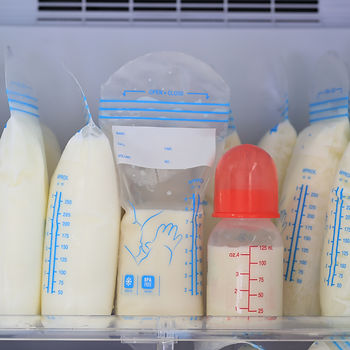
Either way, rotation matters. Freezer milk is good for about 6–12 months in a standard freezer, but fresher is always better nutritionally and in terms of taste. Use a first-in, first-out system, labeling each bag with the date, and work through your oldest milk before reaching for newly pumped batches.
Give yourself permission to recalibrate
Stash size isn't a one-time decision. It's something you'll adjust as you learn your baby's appetite, your own pumping output, and your workplace's actual rhythms. The number that felt necessary in theory, sketched out on a spreadsheet before you returned to work, often looks different once you're three weeks into the real routine. That's normal, and it's a sign you're responding to your actual circumstances rather than a generic rule.
There is no gold-star amount of frozen milk that proves you're a good or prepared parent. A thinner stash paired with a solid, flexible pumping and feeding plan will serve your baby just as well as a packed freezer—often with far less stress along the way.
When to call for help
Reach out to an IBCLC or your pediatrician if you notice a sudden, unexplained drop in your pumping output, if you're experiencing recurring clogged ducts or mastitis symptoms, or if you're unsure whether your baby's intake matches typical growth patterns. A lactation consultant can also help you build a personalized return-to-work pumping schedule, troubleshoot low supply or oversupply, and talk through paced feeding strategies with your caregiver. If anxiety about your stash is affecting your sleep, your pumping sessions, or your overall wellbeing, that's worth mentioning to your provider too—support exists, and you don't have to solve this alone.
Staff writer
Editorial Team