Building a stash
How to create a milk reserve without causing an oversupply.
Staff writer
3 min readNovember 3, 2026
# Building a stash
Somewhere between your first successful pumping session and your first real conversation about returning to work, the idea of "the stash" starts to feel urgent. Social media doesn't help — deep freezers lined with neat rows of frozen milk bags have become their own kind of status symbol. But a stash isn't a trophy. It's a tool. And like any tool, it works best when it's built with intention, not panic.
The truth is, most families don't need hundreds of ounces tucked away. They need a modest, sustainable reserve that covers real gaps — a night out, a return-to-work transition, an illness, an unexpected separation — without throwing your milk supply into chaos. Oversupply isn't just uncomfortable; it can lead to plugged ducts, mastitis, and a feeding relationship that feels more like crisis management than nourishment. Let's talk about how to build a stash that actually serves you.
Start with the "why," not the "how much"
Before you add a single bag to the freezer, ask yourself what this milk is actually for. Are you returning to work in eight weeks and need enough for daytime feeds during the transition? Are you planning one night away for a wedding? Are you simply anxious about supply and want a buffer?
Your answer changes everything. A parent returning to a 9-to-5 job needs a working stash that replenishes daily — not a frozen mountain, but a rotating system where today's pumped milk often becomes tomorrow's bottle. A parent planning a single weekend away might need only 20–30 ounces total.
Knowing your actual goal keeps you from chasing an arbitrary number pulled from a Facebook group. Most lactation consultants will tell you the same thing: a two-to-three-day supply is a reasonable cushion for almost any family. Beyond that, you're often pumping for the freezer rather than for your baby, and that's where supply problems tend to start.
Pump with purpose, not volume
The biggest oversupply mistake is well-intentioned: adding extra pumping sessions on top of a baby who is already nursing efficiently and frequently. Your body doesn't know the difference between "building a stash" and "feeding twins." It simply responds to demand. Add demand, and supply rises to meet it — sometimes dramatically, sometimes in ways that are hard to walk back.
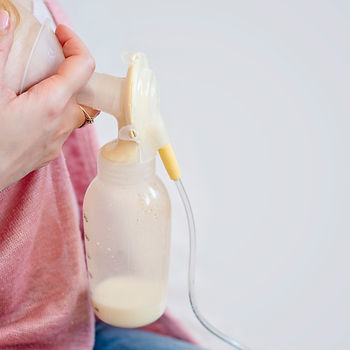
Instead, work with your body's natural rhythms. Many parents find success pumping once in the morning, when milk volume is typically highest, rather than adding multiple extra sessions throughout the day. Others use the "pump the opposite breast" method — while baby nurses on one side, pumping the other side for 10–15 minutes to collect milk that would otherwise go unused.
The goal isn't to make more milk than your baby needs. It's to capture the milk your body is already making efficiently.
This distinction matters enormously. A stash built from genuine surplus — milk expressed after a feed when the breast still feels soft but not empty, or from a single consistent morning session — tends to be sustainable. A stash built from aggressive, supply-boosting pumping schedules often comes with a painful correction later, when you stop pumping as much and your body has to recalibrate downward.
Time it to your baby's age and needs
Timing matters as much as technique. In the first two to three weeks postpartum, your supply is still calibrating to your baby's needs through a delicate feedback loop of hormones and frequent removal. This is not the window for stash-building. Adding pumping sessions this early is one of the most common causes of oversupply, and it can also create forceful let-down or overactive flow that makes nursing harder for baby, not easier.
Most lactation consultants recommend waiting until milk supply feels well-established and breastfeeding is going smoothly — often around three to four weeks postpartum — before introducing regular pumping for storage. By this point, your body has a clearer sense of baseline demand, and added pumping is less likely to be interpreted as a permanent increase in need.
If you're returning to work, work backward from your return date rather than starting as early as possible. Four to six weeks of modest, consistent pumping is usually enough to build a comfortable buffer without months of excess production you'll need to manage.
Store smart so nothing goes to waste
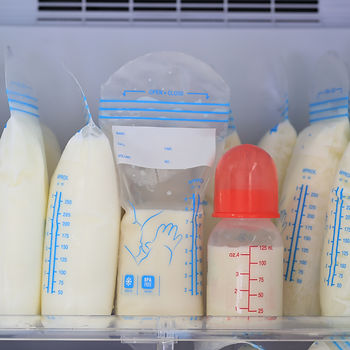
A stash is only useful if it's organized, labeled, and rotated properly. Use the oldest milk first — a simple "first in, first out" system keeps your freezer from becoming an archaeological dig. Label each container with the date it was expressed, and if you're storing for daycare or a partner, include the ounce amount for easy portioning.
Store milk in small, usable quantities — two to four ounces per bag or container — rather than large batches. Small portions thaw faster, reduce waste from leftover milk after a feed, and make it easier to combine fresh amounts without guesswork. Fresh breast milk can typically be stored in the back of the refrigerator for up to four days, and in a deep freezer at or below 0°F for six to twelve months, though using it within six months preserves quality best.
Leave a little room at the top of each container before freezing — milk expands as it freezes, and overfilled bags have a way of splitting at the worst possible moment. And resist the urge to combine freshly expressed warm milk directly with already-chilled or frozen milk; cool fresh milk in the refrigerator first, then add it to existing cold stock.
Know what "enough" really looks like
It's worth saying plainly: you do not need a freezer stocked for a hypothetical apocalypse. Pediatric guidance and lactation consultants alike point to a simple benchmark — enough milk for the separations you actually anticipate, plus a small buffer for the unexpected. For most working parents, that means enough for two to three days, since fresh milk can be produced daily once a pumping routine is established alongside work.
If you find yourself pumping obsessively to reach a specific ounce count, or feeling anxious when the freezer isn't full, it may be worth pausing to examine where that pressure is coming from. Social comparison, well-meaning relatives, or online stash photos can create a sense of inadequacy that has nothing to do with your baby's actual needs. Your baby doesn't need a freezer full of milk. They need a feeding relationship that works for your family, today.
When to call for help
Building a stash should feel manageable, not like a second job layered on top of new parenthood. If you notice signs of oversupply — frequent engorgement, recurrent plugged ducts, a baby who struggles with fast or forceful flow, or chronic fullness that doesn't resolve between feeds — reach out to an IBCLC. These symptoms are very treatable, but they respond best to early, informed adjustments rather than continued pumping on the same schedule.
Similarly, if you're struggling to pump any extra milk at all despite a healthy nursing relationship, that's not a failure — it may simply mean your body is efficiently calibrated to your baby's direct needs, which is exactly how breastfeeding is designed to work. A lactation consultant can help you find realistic, low-pressure ways to build a small buffer without disrupting what's already going well.
And if you're ever uncertain about storage safety, milk that smells off, or how to handle a freezer malfunction, don't guess — a lactation consultant or your pediatrician's office can walk you through it. A stash is meant to bring peace of mind, not one more thing to worry about. With the right pace and the right expectations, it can do exactly that.
Staff writer
Editorial Team