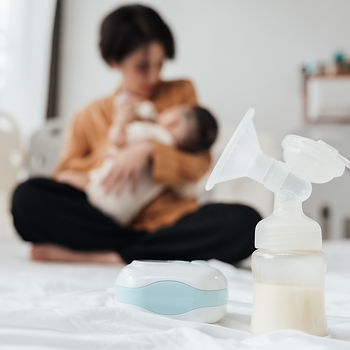
Troubleshooting low pumping volume
Adjust your pumping routine to better reflect your true production capacity.
Staff writer
4 min readSeptember 20, 2026
Opening your flange collection kit one more time to see if a different size might finally unlock more milk is a familiar moment for so many pumping parents. You've done everything "right"—clean equipment, consistent schedule, maybe even a double electric pump recommended by three different friends—and still, the collection bottles show less than you expected. Before you spiral into worry about your supply, let's talk through what's actually happening here, because low pump output often has far more to do with pumping mechanics than with how much milk your body is making.
Your pump output isn't your true supply
This is the single most important mental shift to make: a pump is a tool, not a measuring cup for your milk production. Babies are remarkably efficient at extracting milk in ways that mechanical suction simply cannot replicate. A baby's tongue, palate, and suck-swallow-breathe rhythm work together with real-time feedback your body responds to instantly. A pump, however well-designed, is a blunt instrument by comparison.
Many parents pump four, five, even six ounces at the breast feeds and then panic when a pumping session yields half that. This discrepancy doesn't mean milk has vanished—it often means the pump isn't communicating with your body the same way your baby does. Lactation consultants see this constantly: a thriving, well-fed baby paired with "disappointing" pump numbers. If your baby is gaining weight appropriately, having adequate wet and dirty diapers, and seems satisfied after feeds, your supply is very likely fine. The problem is in the extraction, not the production.
A pump is a tool, not a measuring cup for your milk production.
Flange fit matters more than almost anything else
If there's one single fix that resolves the most pumping frustration, it's flange sizing. The flange—the funnel-shaped piece that fits against your breast—needs to allow your nipple to move freely in and out during the pumping cycle without excessive friction against the tunnel walls. Too small, and your nipple rubs painfully with each cycle, which both hurts and restricts milk flow. Too large, and too much areola gets pulled into the tunnel, which can cause tissue to block the ducts near the nipple base, limiting how effectively milk is removed.
Most pumps ship with a standard flange size that fits a smaller percentage of users than manufacturers would like you to believe. Your nipple diameter can also change over the course of a feeding journey—postpartum swelling, weight changes, and the simple passage of time can all shift what fits. If you haven't reassessed your flange size in the last few months, this is worth doing before any other troubleshooting.
A properly fitted flange should allow your nipple to move with minimal rubbing, with only a small amount of areola tissue drawn in, and your nipple shouldn't turn white or feel pinched during the cycle. Many lactation consultants recommend trying sizes both slightly smaller and slightly larger than what you're currently using to compare comfort and output directly.
Suction and cycle settings need personalization, not maximum power
A common misconception is that higher suction equals more milk. In reality, cranking your pump to its highest setting can actually suppress let-down and reduce output, because excessive pain or discomfort triggers your body's stress response, which works against the oxytocin release needed for milk to flow.
Instead, think in two phases, mimicking what a baby naturally does at the breast. The first phase should use faster, lighter suction to stimulate let-down, similar to a baby's quick non-nutritive sucking at the start of a feed. Once you feel your milk beginning to flow, switch to a slower, deeper suction pattern that better mimics sustained nutritive sucking. Most modern pumps have these two modes built in, often labeled "stimulation" and "expression," but many parents don't realize they should switch between them.
The right suction level is the highest setting that remains comfortable—not painful, not even "a little intense." If you find yourself gritting your teeth, dial it back. Pain restricts flow; comfort supports it.
Hands-on techniques can dramatically increase yield
Breast massage and compression before and during pumping sessions are not optional extras—they are often the difference between a disappointing session and a genuinely productive one. Research on hand expression combined with pumping consistently shows significantly higher milk volumes than pumping alone.
Before you start, spend a minute or two massaging your breasts gently in circular motions, working from the outer tissue toward the nipple. This encourages milk already in your ducts to move toward the collection point and can trigger an earlier, stronger let-down.
During the session, once flow slows (which typically happens a few minutes in), use your hands to apply gentle compression to the breast tissue, essentially helping push milk toward the nipple the way a baby's jaw motion does. Many parents find that a second or even third wave of milk appears after flow seems to have stopped, simply because they added compression at that point rather than ending the session.
Timing, warmth, and your nervous system
Milk removal is deeply tied to your nervous system state, which is why anxious pumping sessions—rushing on a work break, pumping while scrolling through a stressful email thread—so often yield less than relaxed sessions at home. Oxytocin, the hormone responsible for let-down, is notoriously sensitive to stress, cold, and distraction.
Warmth helps enormously. A warm compress or a few minutes under a warm shower before pumping can soften tissue and encourage flow. Many parents find that looking at a photo or video of their baby, or even just their baby's worn clothing, triggers a faster and stronger let-down than pumping without any sensory connection to their child.
Timing also matters. If you're a working parent trying to replicate what your baby would take in a bottle during separation, remember that pump sessions ideally mirror feeding frequency, not just total daily output in one or two long sessions. Short, more frequent sessions often outperform infrequent marathon ones, both for comfort and for total yield across the day.
Equipment wear affects output more than people expect
Pump parts degrade with use, and this degradation is often invisible until it significantly impacts suction strength. Valves, membranes, and tubing can develop micro-tears or lose elasticity over months of regular use, quietly reducing the vacuum strength your pump can generate even though the motor itself works perfectly fine.
Most manufacturers recommend replacing valves and membranes every one to three months with regular use, though this varies by brand and usage intensity. If your pump suddenly seems less effective than it used to be, and you've ruled out fit and technique issues, worn parts are a very reasonable next suspect. This is an easy, inexpensive fix that's frequently overlooked simply because parts look fine to the naked eye even when their function has declined.
When to call for help
If you've worked through flange sizing, suction settings, hands-on techniques, and equipment checks, and your output still feels persistently low or is dropping over time, it's worth connecting with an IBCLC for an individualized assessment. This is especially true if your baby is also showing signs of inadequate intake—fewer wet diapers than expected, slow weight gain, or persistent fussiness at the breast.
A lactation consultant can assess your pump fit in person, review your technique, and help rule out less common issues like hormonal factors, retained placental tissue, or thyroid concerns that occasionally affect supply independent of pumping mechanics. You should also reach out promptly if pumping has become consistently painful, if you notice signs of a clogged duct or mastitis, or if you simply feel overwhelmed trying to troubleshoot alone. You don't have to figure this out in isolation, and getting experienced eyes on your specific situation is often the fastest path to both more milk and more peace of mind.
Staff writer
Editorial Team